Receive first-hand news on the latest bond issues, credit updates and special events when you join us on our Telegram channel at https://t.me/bondsupermart!
Highlights:
- International travelling is seeing a recovery as most countries reopen their borders. Korean Air's passenger load factor reached 80.0% in 1H2022, which is close to its pre-pandemic level. The revenue and profit marked a significant improvement.
- Credit-wise, the leverage declined to a decent level after a notable increase in cash balance. We expect the credit quality to have ample room for further improvement along with the upward-moving revenue.
- The bond due in 2025 is currently yielding 5.3%. Investors seeking stable income can consider it.
As the industry was adversely affected by the epidemic, global airlines have been experiencing a tough time in the past two to three years, with some struggling and even collapsing. However, as the world steps into the post-pandemic era and most countries reopen their borders, the industry is seeing hope. In this Idea of the Week, we will study Korean Air to explore its bond investment opportunities.
Company Background
Founded in 1962, Korean Air is the flag carrier of South Korea. The company is listed on the Korea Exchange with the stock code 003490.KR and its current market capitalisation reached roughly KRW 8.1 trillion. As of 30 June 2022, Korean Air is the largest airline in Korea with a total fleet of 154 aircraft, including 131 passenger aircraft, and offers more than 120 routes. Data from IATA depicts that Korean Air is the 19th largest airline in the world in terms of total passenger traffic and the 5th largest airline in the world in terms of cargo traffic.
Plummet on Revenue
Since the outbreak of the pandemic in 2020, countries tightened international travel policies, taking the airline industry to its nadir. Korean Air is no exception to this trend, with its operating performance deteriorating significantly in 2020 (Chart 1) and total revenue dropping 37.9% YoY to KRW 7.7 trillion. Although its revenue in 2021 improved slightly, it still represents a 27.4% decline compared to 2019.
Chart 1: Revenue and Profit of Korean Air
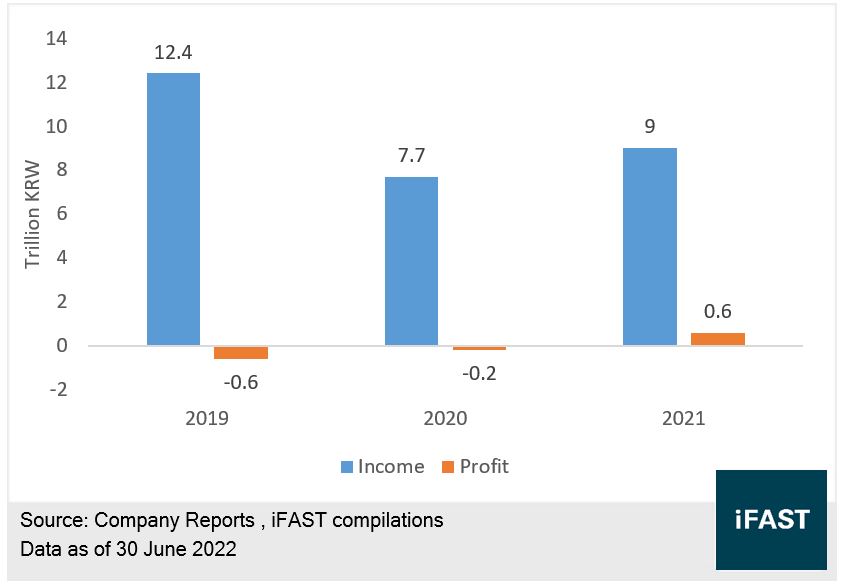
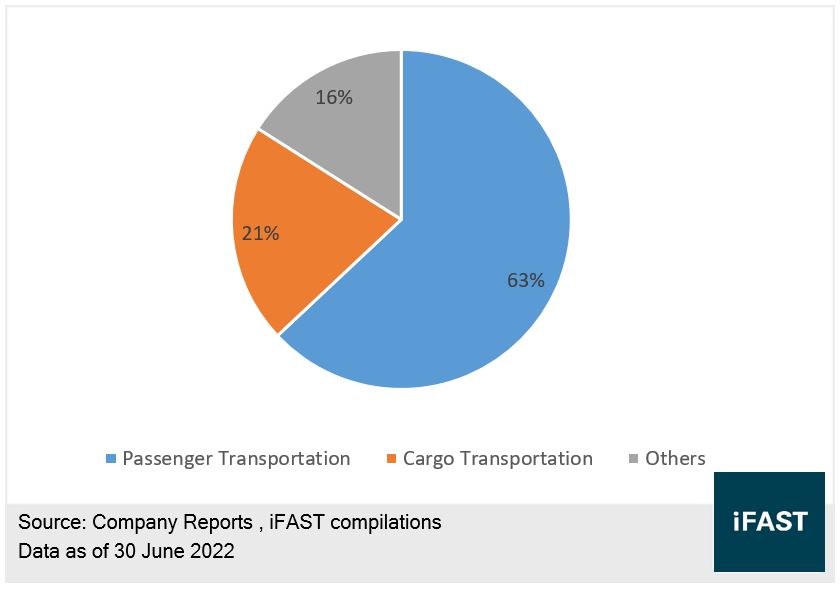
Objectively speaking, comparing with the average plummet of 80% to 90% of its peers, Korean Air's overall track record looks acceptable. This is due to the fact that Korean Air is more exposed to the cargo business, which contributed more than 20% of the revenue before 2020, and is less susceptible to the pandemic, resulting in a resilience in its revenue (Chart 2).
Chart 2: Korean Airline’s Revenue Breakdown in 2019
Korean Air Robustly Recovers amid the Post-pandemic Era
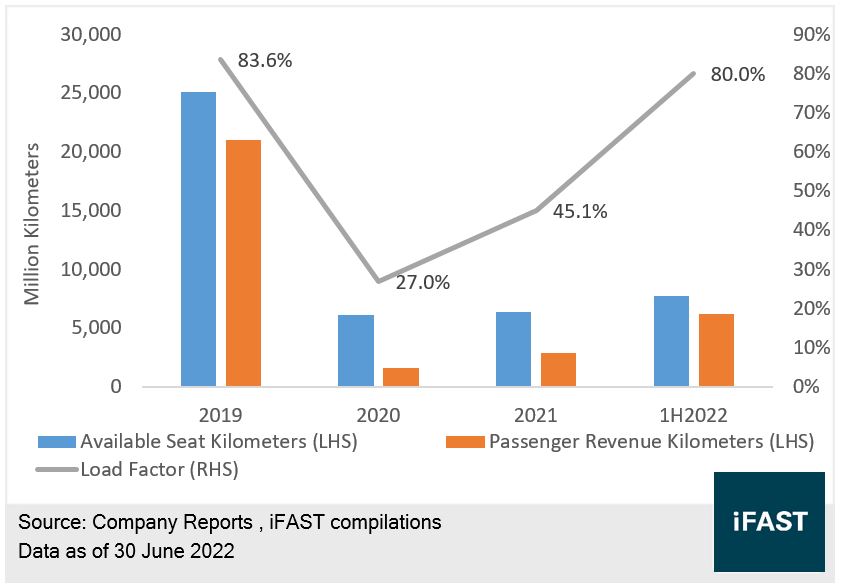
Airlines are finally seeing hope as most countries, including Korea, declare their co-existence with the virus and lift the ban on international travelling in 2022. Consequently, Korean Air is experiencing a robust recovery, with available seat kilometers (Kilometers traveled multiply by the number of available seats, an indicator for measuring capacity) rising from 6,387 million kilometers in 2021 to 7,728 million kilometers in the first half of 2022, while passenger revenue kilometers (a measurement of an airline’s operation performance, calculated by multiplying the kilometers traveled by the number of passengers, ) also improved significantly to 6,186 million kilometers, hence the passenger load factor (passenger / available seat) in 1H2022 stood at roughly 80%, close to the pre-pandemic level of 83.6% in 2019.
Chart 3: Operation Records of Korean Air
We also noticed that Korea gradually eased its pandemic regulations and entry restrictions since March this year, and the current inbound tourism policies are almost the same as the pre-pandemic ones. It suggests that domestic consumption and airlines could benefit much from the changes, we thus believe that Korean Air's operating performance will greatly improve going forward.
Table 1: Changes in Korea’s Inbound Tourism Policies
|
Changes in Policies |
|
|
Mar-22 |
No quarantine is required for entrance into Korea for those who have been vaccinated |
|
Apr-22 |
Revoke almost all Covid restrictive measures |
|
Jun-22 |
No quarantine is required for all visitors entering Korea |
|
Sep-22 |
No PCR test is required before entry into Korea |
|
Oct-22 |
No PCR test is required after entry into Korea |
|
Sources: Korea Tourism Organization, iFAST Compilations Data as of 1 October 2022 |
|
Korean Air to Be Top 10 Airline by the Acquisition of Asiana Airlines
In November 2020, Korean Air proposed to acquire Asiana Airlines, the second largest airline in Korea, for a price of KRW 1.8 trillion. After a review by the Korea Fair Trade Commission, the acquisition has been approved in February this year, and Korean Air is awaiting further approval by other authorities from the USA, EU, Japan, China, and the UK.
If the acquisition succeeds, Korean Air's fleet will reach approximately 240 aircraft, and is expected to become the top 10 airlines in the world. It is worth noting that Korean Air derives approximately 60% of its revenue from domestic routes, while Asiana Airlines has a higher proportion of international routes. If they are merged, there will be significant complementary and synergistic effects that will lead to a more promising future.
Full-scale Improvement in Credit Indicators
From 2020 to 2021, Koran Air's weak operation records have also dragged down its credit profile, for example, cash flow from operating contracted from KRW 1.7 trillion in 2019 to KRW 0.8 trillion in 2020, and both borrowings and leverage trended upward to a varying degree.
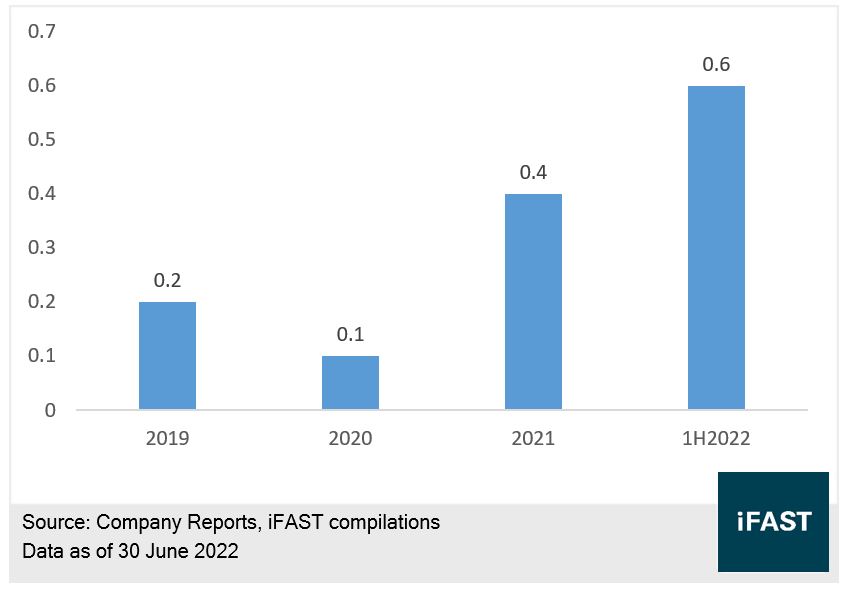
However, the credit metrics are improving along with the recovery of operation, as the cash flow from operating to current liability ratio swelled from 0.1x in 2020 to 0.6x in 1H2022 (Chart 4). Hinting that the cash generated from its operation could be able to cover 60% of total current liability, and liquidity improved remarkably with a lower reliance on external funding.
Chart 4: Cash Flow From Operating to Current Liability Ratio
Looking into other credit metrics (Table 2), as of June 2020, the total borrowing amounted to KRW 11.7 trillion, down from KRW 12.1 trillion at the beginning of this year, while cash and cash equivalents rose to KRW 4.8 trillion. Meanwhile, Korean Air's net gearing ratio decreased from 120.0% in end-2021 to 87.3%, and the total debt/EBITDA ratio notably dropped to 2.8x, suggesting a lower leverage and pressure for debt repayment.
Table 2: Korean Air’s Credit Metrics
|
(Trillion KRW) |
2021 |
1H2022 |
|
Cash and Cash Equivalents |
3.7 |
4.8 |
|
Total Debt |
12.1 |
11.7 |
|
Net Gearing Ratio |
120.0% |
87.3% |
|
Total Debt/ EBITDA |
3.9X |
2.8X |
|
Sources: Company Report, iFAST Compilations Data as of 30 June 2022 |
||
The Bond due in 2025 Yields Over 5%
There is one Korean Air bond available for trading on our platform. The specification is shown below:
Table 3: The Bond Issued by Korean Air
|
Bond |
Bond Credit Rating |
Years to Maturity |
YTM |
|
KOREAN 4.750% 23Sep2025 Corp (USD) |
AA (S&P) |
2.9 |
5.3% |
|
Source: Bondsupermart Data as of 20 Oct 2022 |
|||
This bond has a credit rating of AA (S&P), the same as the sovereign rating for Korea, and is currently trading with a yield to maturity of 5.3%, making it attractive among upper investment-grade bonds. Investors seeking stable income can consider it.
Corporate Risk
Investors should be mindful of the following risks. Firstly, Korean Air is exposed to foreign exchange risks. Since the beginning of the year, the Korean won has depreciated by more than 20% against the US dollar, hitting a 13-year low. As of June 2022, Korean Air's foreign currency-denominated debt accounted for 61% of total debt, signaling that the company's debt repayment amount will amplify if the Korean won continues to depreciate.
Moreover, from the angle of operating cost breakdown, fuel expense constitutes approximately 40% of the total cost. In the second quarter of this year, due to the increase in global oil prices, the company's fuel price increased by roughly 100%, resulting in a 144.9% YoY increase in fuel expenses. As the current oil prices remain high, the Company's operations may be negatively impacted, which in turn may weaken its credit quality.
Conclusion
International travelling is seeing a recovery as most countries reopening their borders. Korean Air's passenger load factor reached 80% in 1H2022, which is close to the pre-pandemic level. The revenue and profit marked a significant improvement. Credit-wise, the leverage declined to a decent level after a notable increase in cash balance. We expect its credit quality to have ample room for further improvement along with the upward-moving revenue. The bond due in 2025 is currently yielding 5.3%. Investors seeking stable income can consider it.
Declaration: For specific disclosure, at the time of publication of this report, IFPL (via its connected and associated entities) and the analyst who produced this report hold a NIL position in the abovementioned securities.
Our podcast series, Yield Hunters, is available on Spotify, iTunes Podcasts and Google Podcasts. We share our thoughts on new bond issues and hold discussions on the fixed income space. Listen to our latest episode below and follow us!